GIGI PORTAL
Loading page…
Z.ai
Z.ai Research Blog, 14 August 2026.
GLM-5.3 is Z.ai’s post-training-only upgrade of its GLM-5 flagship: same base model as GLM-5.2, pushed much further on coding and long-horizon agent work by scaling environments, task diversity, and RL compute. It also unexpectedly developed strong cyber capability — finding bugs and chaining exploits — and proved it on 2,436 real vulnerabilities across 269 open-source projects.
It shows a second scaling axis still has headroom: better environments plus verifiable rewards can deliver 50% coding gains and new cyber skills without training a new base model. For builders this means frontier-class open coding agents with lower token bills, and for defenders it means AI vulnerability discovery at a scale (45 years of latent flaws, some dating to 1981) that demands public disclosure infrastructure. Z.ai pairs the release with its slime RL framework, a disclosure ledger, and open weights after safety hardening.
The core paper simplified
Z.ai did not train a new foundation model. GLM-5.3 keeps the GLM-5.2 base and pours everything into post-training: IndexShare for efficient long-context processing, SAO for RL on long-horizon tasks, and the open-source slime trainer for large-scale asynchronous RL — fed with steadily more environments, more diverse tasks, and more compute.
Training environments now mirror real expert work — e.g. an ML-infrastructure task with clusters, storage, docs, codebases, and experiment results where the model must diagnose bottlenecks and ship a measured end-to-end speedup. Pipelines synthesize runnable long-horizon environments end to end, a judge agent checks solvability, and verifiers built without the reference solution must pass oracle, no-op, and unsolved-state checks. SAO with compaction carries the gains to long horizons: Terminal-Bench 3.0 from 4.6 to 28.3, DeepSWE v1.1 from 46.2 to 66.9, Agents’ Last Exam from 23.8 to 28.5.
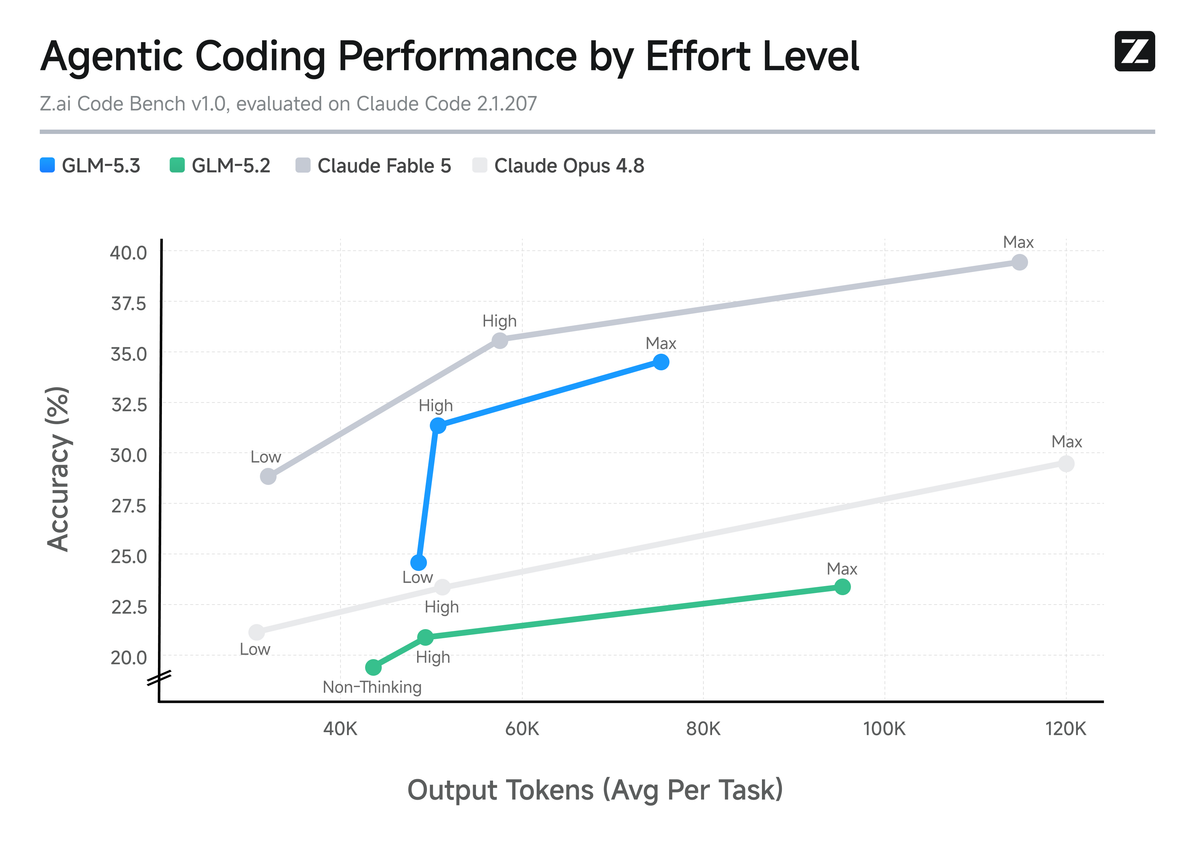
Curves of end-to-end completion rate against output tokens per task. GLM-5.3 sits up and to the left of GLM-5.2 everywhere: higher accuracy for fewer tokens, with closed-model reference points at High and Max effort.
Post-training scaling buys both capability and efficiency — better answers for ~22% fewer tokens at Max effort.
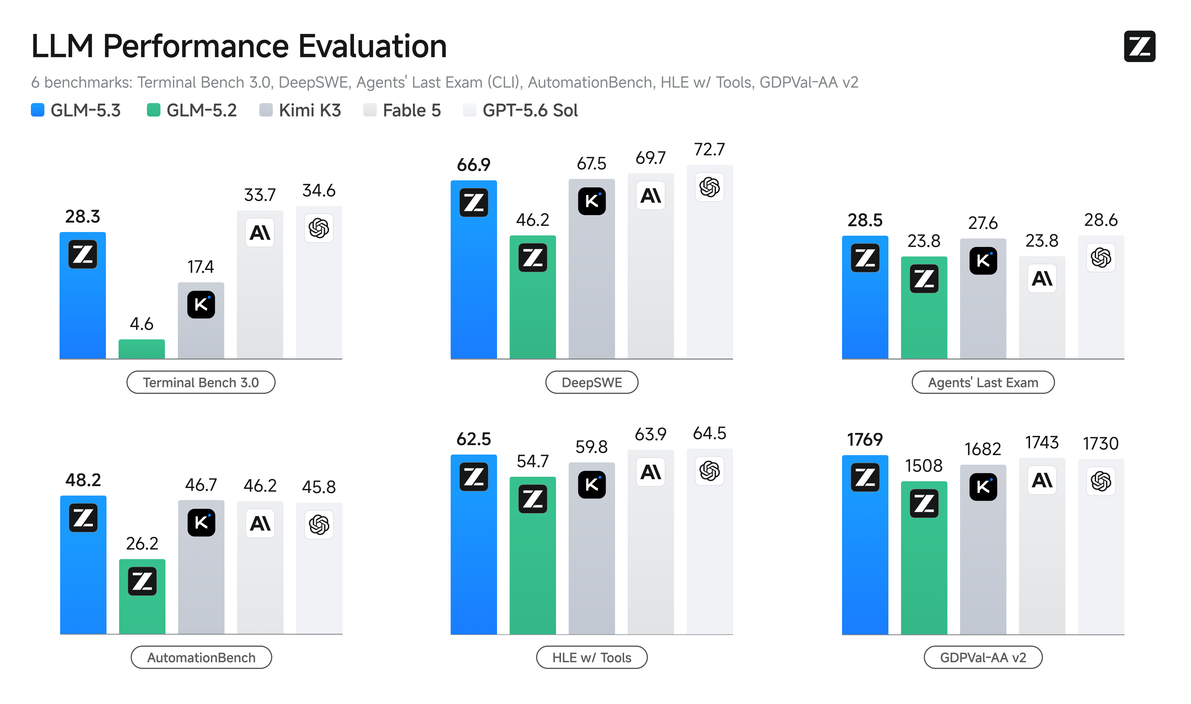
Six grouped bar charts with vendor marks on each bar. GLM-5.3 leads on Terminal-Bench 3.0 (28.3), DeepSWE (66.9), Agents’ Last Exam (28.5), AutomationBench (48.2), HLE with tools (62.5), and GDPval-AA v2 (1769) — ahead of GLM-5.2 everywhere and trading blows with Fable 5 and GPT-5.6 Sol.
The biggest deltas over GLM-5.2 cluster in the hardest coding and agentic tasks — exactly the long-horizon work post-training targeted.
Against eight models (GLM-5.2, Kimi K3, DeepSeek-V4-Pro-0813, Qwen3.8-Max, Opus 4.8, Fable 5 with fallback, GPT-5.6 Sol) GLM-5.3 sweeps its predecessor and takes open-weights SOTA on Terminal-Bench 3.0 and ALE-CLI while staying competitive on Terminal-Bench 2.1 (88.2), NL2Repo (58.0), Toolathlon (73.0), AutomationBench (48.2), HLE with tools (62.5), and GDPval-AA v2 (1769).
Vulnerability-discovery data was added to teach reasoning about flaws; as training scaled the model began planning multi-stage exploitation chains. CyberGym (white-box fault triggering) hits 84.5%, up from 77.2 and ahead of Mythos 5 (83.8) and GPT-5.6 Sol (83.6). ExploitBench (deep real-vuln reasoning) more than doubles to 54.4% from 24.4 (Mythos 78.0, GPT 76.5). ExploitGym (time-normalized exploitation) jumps to 105 tasks in 2h and 130 in 6h from 29/39 (Mythos 181/247). The rule holds: the further up the exploitation chain, the larger the gain over GLM-5.2 — and the wider the remaining gap to closed frontier.
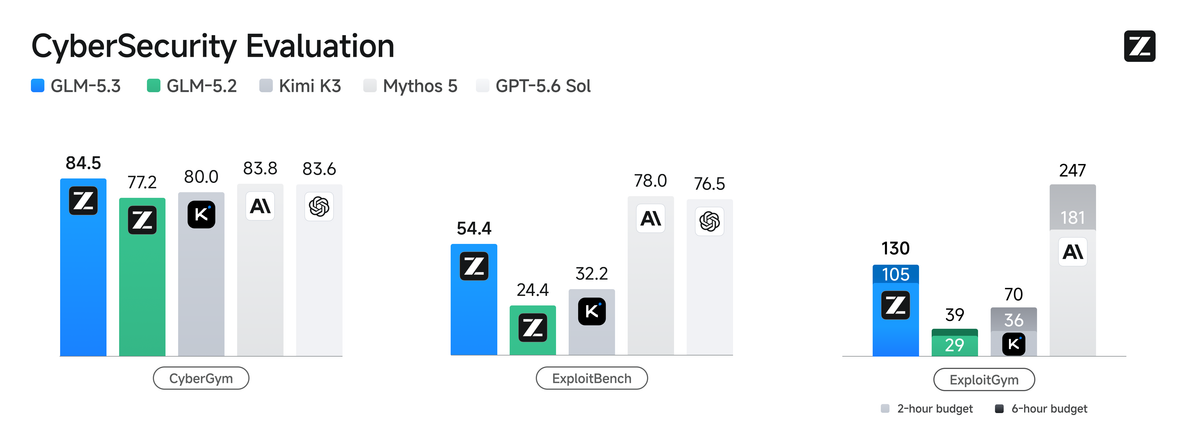
Three cyber benchmarks ordered by exploitation depth, each showing GLM-5.3 vs GLM-5.2 vs closed frontier. Bars widen in Z.ai’s favor moving right, while the absolute lead of Mythos/GPT persists at the far right.
Capability is growing fastest exactly where Z.ai is furthest behind — a classic scaling signature with safety implications (weights held two weeks for hardening).
With Chinese security partners the model scanned real codebases: 2,436 findings across 269 projects (1,097 critical and high; 107 critical, 990 high, 1,286 medium, 53 low), spanning kernels, operating systems, browser engines, infra, web apps, and protocols — oldest flaw introduced in 1981, mean dwell 26.6 years. The Z.ai Security Disclosure Ledger (cvd.z.ai) tracks 53 publicly disclosed vs 2,383 under embargo across 45 years of impact.
All of this runs on slime (Megatron training + SGLang rollout on one dataflow, so sandboxes and verifiers plug in as data, not loop changes): top-p masks, top-k and full-vocabulary OPD, R3-style training-rollout consistency to 1e-7 logprob (99.99% reduction), hierarchical local caching, multi-teacher OPD without per-teacher services, and workload-aware prefill/decode ratios and concurrency — over 2.3× end-to-end RL throughput on long-horizon coding. Shipping: thinking is now always on (low/high/max, default max, max recommended for code; disabled requests fail), points-based Coding Plan (peak 14:00–18:00 UTC+8 Mon–Fri, 50% off-peak), ZCode perks (98%+ cache hit for ~30% more effective tokens, 1.5× quota boost to 180% through Aug 31, Goal mode, WeChat/Feishu phone Remote Control), and local weights in two weeks.
Key performance metrics, memory benchmarks, and milestone numbers
Z.ai Team (2026). GLM-5.3: Frontier Coding with Emergent Cyber Capabilities. Z.ai Research Blog. Transcribed on Gigi Papers.Transcribed from the Z.ai blog edition; benchmark tables preserved in prose and figures hosted locally from the original CDN. © Z.ai · Original at https://z.ai/blog/glm-5.3