GIGI PORTAL
Loading page…
P. K. Shternberg Astronomical Institute
Soviet Astronomy–AJ, Vol. 8, No. 2, Sept.–Oct. 1964. Translated from Astronomicheskii Zhurnal, Vol. 41, No. 2, pp. 282–287, March–April 1964. Original article submitted December 12, 1963.
Basically: the Kardashev scale measures how much energy a civilization can harvest — and humanity currently sits at K ≈ 0.73, about 20 terawatts.
The protracted duration of signal propagation is a determining factor in the one-way transmission of information through space. Reliable reception, or any reception at all, of signals by unknown subscribers necessarily requires an Equal in all directions. Only an isotropic broadcast can reach unknown listeners anywhere. emission. The optimum signal spectrum for transmitting the maximum amount of information in the presence of At tiny scales nature is grainy; quantum fluctuations set the ultimate floor for detecting faint signals. noise and the background of cosmic radio-frequency emission has been calculated. It is shown that a civilization located at any distance in the universe and in possession of power on the order of L⊙ ≈ 4 × 10³³ A centimetre–gram–second unit of energy (10⁻⁷ joules). Cosmic power outputs are quoted in ergs per second./sec or more, which it is capable of transmitting in a coded Equal in all directions. Only an isotropic broadcast can reach unknown listeners anywhere. radio-frequency signal, may be detected by conventional radio astronomical techniques. The expected distinguishing properties of artificial sources of cosmic radio-frequency emission are enumerated. It is speculated that even some sources known to us today (notably A then-mysterious radio source Kardashev flagged as possibly artificial; later identified as a quasar. and A then-mysterious radio source Kardashev flagged as possibly artificial; later identified as a quasar.) may be artificial radio sources.
The principal factors which exert a determining effect on the range of space radio communications are the transparency of the interstellar medium to radio signals, the level of the equipment noise and space noise, and the power of the transmitters. The greatest possible range for establishing space communications could be set most likely in the range from 10⁹ to 10¹¹ Cycles per second — the 1960s name for hertz (Hz), the unit of frequency. [1]. The absorption coefficient of the interstellar medium is negligibly small at those frequencies. The equivalent noise temperature may be represented in the form:
T_N = T_n + T_t + T_qwhere T_n and T_t are respectively the temperature due to Radio glow from electrons spiralling in magnetic fields — part of the cosmic background this search must see past. radiation and due to background thermal cosmic radio emission, and the equivalent noise temperature due to At tiny scales nature is grainy; quantum fluctuations set the ultimate floor for detecting faint signals. fluctuations in the minimum detectable signal is:
T_q = hf/k(h and k are the Planck constant and the Boltzmann constant). The expression for T_N gives an estimate of the limiting sensitivity which might be achieved in the case of an ideal noise-free receiver and observations outside the earth’s atmosphere. In Fig. 1, we find plots of T_N as a function of the frequency in accord with up-to-date radio astronomy data [2]. The paramount role in the establishing of long-range communications within the confines of our galaxy will evidently be played by thermal and nonthermal radio-frequency emission from the galactic disk (over a range of ±50° in longitude on either side of the center of the galaxy). In that case, we have:
T_N = 2·10²⁷·f^−2.9 + 10¹⁹ f^−2 + 4.8·10^−11 f.(1)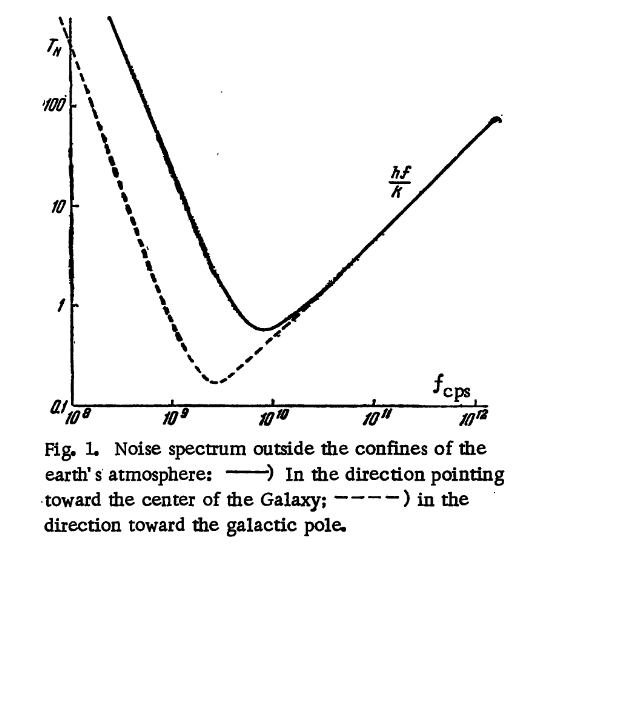
The noise temperature of the background at high galactic latitudes, which is due to Radio glow from electrons spiralling in magnetic fields — part of the cosmic background this search must see past. radiation from the halo and from the The paper’s word for the observable universe: all galaxies within reach of observation., follows:
T_N = 10²⁸f^−2.9 + 4.8·10^−11f.(2)In both cases, the noise temperature will display a deep-sloping minimum in the decimeter and centimeter wavelength ranges, which renders this range more suitable for space communications over exceptionally vast distances.
Let us evaluate the information content of communications channels for application to this problem. The upper bound of the rate of information transmission at a specified average transmitter power and specified noise distribution is determined by the corresponding Claude Shannon, whose theorem gives the maximum information rate of a channel for a given bandwidth and noise. theorem [3]:
R = ∫[f₁ → f₂] log₂[(S(f) + n(f)) / n(f)] df(3)where S(f), n(f) are the functions of the spectral power density of the useful signal and of the noise, respectively. By solving the appropriate variational problem, we may show the maximum rate of information transmission to be achieved under the condition:
S(f) + n(f) = n(f₁) = n(f₂).(4)Here, f₁ and f₂ are the bounds of the transmitter transmission band. It is accordingly quite clear that the spectrum of the artificial source must display the shape of the curve in Fig. 1, but with the sign reversed:
S(f) = n(f₁) − n(f)i.e., the spectrum of the artificial radio emission must feature a maximum, and in a region of frequencies lower than this frequency will fall as a − bf^−2.9, whereas, in the region of higher frequencies, it will fall as a − cf (a, c, b here are constants dependent upon the power and The width of the frequency band carrying the signal. Here it directly sets the information rate in bits per second. of the transmitters and on the noise distribution).
To make a rough estimate of the rate of information transmission, there is of course no need to take the logarithmic term in Claude Shannon, whose theorem gives the maximum information rate of a channel for a given bandwidth and noise.’s theorem into account. The rate of information transmission R = f₂ − f₁ = Δf then, i.e., it will be equal to the system The width of the frequency band carrying the signal. Here it directly sets the information rate in bits per second.. Let P be the transmitter power, and we shall assume the radiation Equal in all directions. Only an isotropic broadcast can reach unknown listeners anywhere.. There appears to be no point, in our view, in discussing the possibility of establishing outer space communications when high-How tightly an antenna focuses power. Beaming far is efficient, but useless for hailing unknown listeners. antennas [4] are being used for transmission, since the probability of success in establishing such communications is virtually nil. The high How tightly an antenna focuses power. Beaming far is efficient, but useless for hailing unknown listeners. of the radiation can be conveniently used, in all probability, only after a two-way communication exchange has been set up, and if we bear in mind the fact that the distances between the two civilizations in question may be comparable to or even more enormous than the dimensions of our galaxy, then this second mode of communications may be brought to fruition much later, and in the meantime the need for Equal in all directions. Only an isotropic broadcast can reach unknown listeners anywhere. radiation geared to establish contacts with new potential listeners will not have abated. Let the transmission be carried out over a The width of the frequency band carrying the signal. Here it directly sets the information rate in bits per second. Δf, and let the maximum expected distance of the transmission be r, with A the effective area presented by the receiving antenna, T_N the noise temperature referred to the input of the receiving antenna. We shall assume the transmission to be reliable when the condition:
100 kT_N = PA / 4πr²Δfis fulfilled, i.e., when there is a 100-fold excess of signal over noise. Then:
Δf = PA / 400πr²kT_N.(5)Consequently, the channel capacity will not be less than Δf bits per second. The radio emission flux per unit frequency interval will not be less than:
F_f = 100 kT_N / A.(6)The most important parameter to deal with in this problem is the power P, about which several hypotheses are in order. Calculations show that the total quantity of energy expended by all of mankind per second at the present time is about 4 × 10¹⁹ A centimetre–gram–second unit of energy (10⁻⁷ joules). Cosmic power outputs are quoted in ergs per second., and the annual increase in this energy expenditure is placed at 3–4% over the next 60 years, on the basis of statistical findings [5]. Now let this increment represent an annual increase in energy consumption by a factor of 1 + x, so that in t years the increase will be:
(1 + x)^t ≈ e^tx (x ≪ 1)Assuming x = 1%, we find that the energy consumption per second will be equal to the output of the sun per second, 3200 years from now, i.e., 4 × 10³³ A centimetre–gram–second unit of energy (10⁻⁷ joules). Cosmic power outputs are quoted in ergs per second./sec, and that in 5800 years the energy consumed will equal the output of 10¹¹ stars like the sun. The figures arrived at seem to be inordinately high when compared to the present level of development, but we see no reasons why the tempo of increase in energy consumption should fall substantially than predicted. Moreover, the availability of a large amount of information forthcoming from other and more highly developed civilizations might contribute to a staggering increase in energy consumption.
In line with the estimates arrived at, it will prove convenient to classify technologically developed civilizations in three types: I — technological level close to the level presently attained on the earth, with energy consumption at ≈4 × 10¹⁹ A centimetre–gram–second unit of energy (10⁻⁷ joules). Cosmic power outputs are quoted in ergs per second./sec. II — a civilization capable of harnessing the energy radiated by its own star (for example, the stage of successful construction of a “Freeman Dyson, who proposed a shell capturing a star’s whole output — the benchmark for a Type II civilization. sphere” [6]); energy consumption at ≈4 × 10³³ A centimetre–gram–second unit of energy (10⁻⁷ joules). Cosmic power outputs are quoted in ergs per second./sec. III — a civilization in possession of energy on the scale of its own galaxy, with energy consumption at ≈4 × 10⁴⁴ A centimetre–gram–second unit of energy (10⁻⁷ joules). Cosmic power outputs are quoted in ergs per second./sec.
Estimates of the possibility of detecting a Kardashev’s planetary civilization: energy on the scale of a planet, or here the mass of a planet’s crust. civilization [7] and related experiments in the “Frank Drake’s 1960 Project Ozma, the first radio search for extraterrestrial signals.” project in the USA have revealed the extremely low probability of any such event. Consider the possibility of detection and reception of information sent by type II and type III civilizations. First of all, we assume here that one of the principal tasks of such communication efforts would be the transmission of information from a more highly developed civilization to a less highly developed one. Starting from the present level of development of radio physics as point of departure, we see that in principle it is possible to build antennas, within the next two decades, with an effective area of 10⁵ m² and with receiving apparatus featuring a noise temperature T_N ≈ 1°K. If a transmitter is designed for this system to receive and record information, Eq. (3) will show that the radio emission flux at the receiving point will be not less than 1.4 × 10^−26 W/m²·Cycles per second — the 1960s name for hertz (Hz), the unit of frequency., an amount which is well within the recording capabilities of presently existing radio telescopes. (Of course, far simpler equipment will be required to detect the signals since, in contrast to the reception of information, here we may utilize the averaging techniques common in radio astronomy, and the Extra sensitivity from averaging a signal over time; it grows with the square root of bandwidth × observing time. √(Δfτ) (where τ is the build-up time) may enhance the sensitivity by 3 to 4 orders of magnitude over a fairly wide signal band.)
We now cite some estimates of the quantity of information obtainable, in line with formula (2). For a type II civilization, we have to take into account the frequency variation of T_N as in accord with formula (1). T_N = 1°K is assumed for a type II civilization. The table lists estimates for three distances corresponding to the transmission of information within the confines of the galaxy, within the confines of a local system of galaxies, and within the confines of the portion of the The paper’s word for the observable universe: all galaxies within reach of observation. accessible to observation. The estimates arrived at show that should there exist even one type II civilization within the confines of the local system of galaxies, there will be a realistic possibility of securing an enormous quantity of information. The same holds for the existence of even one single type III civilization in the portion of the universe accessible to observation. For purposes of comparison, let us estimate the time required to transmit 10⁸ printed and manuscript-form publications now available on the earth through a channel of 10⁹ Cycles per second — the 1960s name for hertz (Hz), the unit of frequency. The width of the frequency band carrying the signal. Here it directly sets the information rate in bits per second.. Assuming that each written work contains an average of about 10⁶ bits of information, we find that the total quantity of 10¹⁴ bits of information may be transmitted in 10⁵ sec, i.e., in a single day. However, it is quite evident that there is no need to transmit all of the 100 million publications in order to broadcast the principal data on the status of science, technology, and culture on the earth, for such information would contain a colossal amount of “The predictable, compressible part of a message. Highly redundant broadcasts carry little new information..” Apparently, all of the basic information could be compressed in 10⁵ books of 10⁶ bits each, which would come to 10¹¹ bits and would take only 100 sec to be transmitted via the same communications channel. Finally, it is entirely reasonable to assume that type II and type III civilizations would be in possession of information many orders of magnitude in excess of what we have available at the present time. For that reason, they would have to be broadcasting practically continually, and this would also be the case for increasing the possibility of reception by Kardashev’s planetary civilization: energy on the scale of a planet, or here the mass of a planet’s crust. civilizations. Moreover, in order to improve the reliability of the information received and in order to afford some opportunity to make connections with new subscribers, there would have to be periodic repetitions of the programs broadcast.
Number of bits per second ∼ Δf. A type II civilization transmitting 4 × 10³³ A centimetre–gram–second unit of energy (10⁻⁷ joules). Cosmic power outputs are quoted in ergs per second./sec attains 3 × 10⁹ bits/sec at 100,000 light years and 3 × 10⁵ bits/sec at 10 million light years, while at 10 billion light years the transmission of a large quantity of information is impossible. A type III civilization transmitting 4 × 10⁴⁴ A centimetre–gram–second unit of energy (10⁻⁷ joules). Cosmic power outputs are quoted in ergs per second./sec attains 2.4 × 10¹⁵, 2.4 × 10¹³, and 3·10¹⁰ bits/sec at the same three distances.
Note again that, in all likelihood, a Kardashev’s planetary civilization: energy on the scale of a planet, or here the mass of a planet’s crust. civilization would be capable of sending a return signal only after its energy consumption had increased measurably. Consequently, the communications would be a one-way affair at the start, and the problem of how long it takes the signals to propagate would be a secondary one.
As is evident from the above estimates of transmitter power for type II and type III civilizations, the figures are very close to the power of Radio glow from electrons spiralling in magnetic fields — part of the cosmic background this search must see past. radiation from nebulas formed in supernova explosions, or from radio galaxies. Calculations of the optimum transmitter The width of the frequency band carrying the signal. Here it directly sets the information rate in bits per second. show that the transmission spectrum may also closely resemble the spectra of discrete radio sources. Several criteria could be singled out which would be useful in discriminating artificial radio sources from the vast number of radio stars accessible to observation.
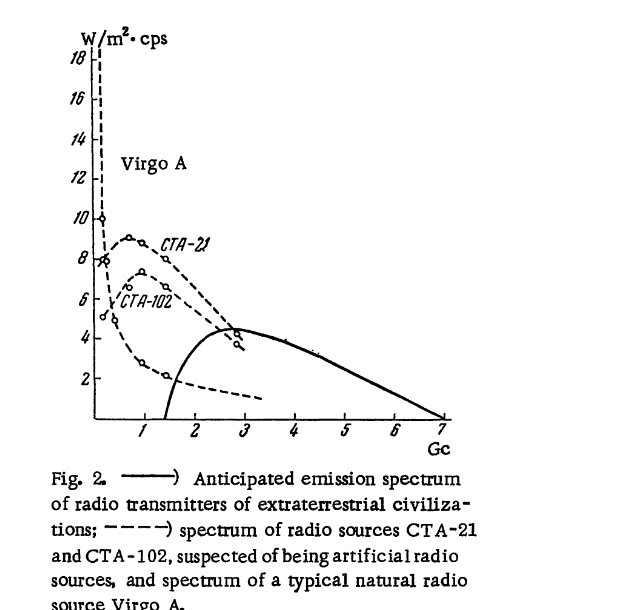
The artificial sources would evidently 1) have to have very small angular dimensions (at least in the case of type II civilizations); the angular dimensions would have to be of the order of the angular dimensions of stars, i.e., less than 0″.001. The now known natural radio sources must have appreciably larger angular dimensions, larger than 0″.01 in fact, according to theory [8]; 2) they would have to possess circular polarization, so that the effect of the Interstellar magnetism twists polarized radio waves (Faraday rotation); circular polarization sidesteps the distortion. rotation of the plane of polarization in the interstellar medium would not distort the information received; 3) they would have to exhibit variability in time without leading to statistical fluctuations; this is obviously a criterion of outstanding importance, but it is possible that a regularity in time variations of the signal might be revealed only in the course of observations using special equipment of wide The width of the frequency band carrying the signal. Here it directly sets the information rate in bits per second. (10⁹ Cycles per second — the 1960s name for hertz (Hz), the unit of frequency.) and of sufficient sensitivity to operate with very short time constants; 4) finally, it is to be anticipated that certain details would be present in the spectrum of the source suspected of artificiality which would have been designed for the express purpose of emphasizing its artificial origin; in particular, we might anticipate such a feature in the environs of the The 1420 MHz hydrogen line — a universal landmark, but a bad message frequency since hydrogen gas absorbs it. wavelength line. Information transmission at that frequency within the confines of this galaxy would be inadvisable, since the signal will be strongly absorbed by neutral hydrogen. It would be reasonable, for that reason, to eliminate a band of 1–2 Megacycles per second — the 1960s name for megahertz (MHz). width, say of rectangular shape, in the continuous spectrum of the artificial source, to lay special emphasis on the unusual nature of the radiation. Considerations involving the anticipated shape of the complete spectrum of the artificial source also deserve close attention. These arguments were cited above when the estimate was made of the quantity of information which could be transmitted. The most characteristic feature of the spectrum is the linear dependence of the flux on frequency in the high-frequency region of the spectrum (cf. Fig. 2).
It is consequently of the utmost importance to carry out a program of studying and searching discrete radio sources, in the immediate future, with due attention paid to the spectral features mentioned here. Note that even at the present time we have knowledge of about twenty to thirty or so radio sources, with the upper limit of the angular dimensions in the range of 1 to 10 1/3,600 of a degree of sky. Smaller means more point-like — a hint of artificiality. [9]. Some of these sources have been identified with peculiar optical objects the nature of which is still obscure [10]. Most of them have not yet been sucessfully identified with optical objects.
For example, two sources of radio-frequency emission from outer space, A then-mysterious radio source Kardashev flagged as possibly artificial; later identified as a quasar. and A then-mysterious radio source Kardashev flagged as possibly artificial; later identified as a quasar., were recently discovered at the California Technological Institute [11], and display angular dimensions not less than 20″, and have not been identified with a single one of the optical objects in the The Palomar sky survey, the optical atlas these radio sources could not be matched to. sky charts and, even more intriguing, these sources exhibit a spectrum highly similar to the anticipated artificial spectrum. Figure 2 presents the observational data reported in [12] on these two sources, alongside the theoretically predicted spectrum. For purposes of comparison, the spectrum of a typical natural radio source, A giant radio galaxy (M87) used here as a typical natural source for comparison., is added (the scale is compressed by a factor of 10 on the ordinate axis in the case of A giant radio galaxy (M87) used here as a typical natural source for comparison.).
The most promising region for a search for artificial radio signals is apparently that in the direction toward the center of the Galaxy, since the density of the stellar population is greatest there along the line of sight. It would also be appropriate to investigate the closest galaxies, and in the first instance the large nebula in the The Andromeda Galaxy, our nearest large spiral neighbour — a suggested search target. constellation and the Two small galaxies orbiting the Milky Way — nearby suggested search targets., as well as the closest radio galaxies A nearby powerhouse radio galaxy (M87) suggested as a search target. and A nearby powerhouse radio galaxy (Centaurus A) suggested as a search target..
In conclusion, we should like to note that the estimates arrived at here are unquestionably of no more than a tentative nature. But all of them bear witness to the fact that, if terrestrial civilization is not a unique phenomenon in the entire universe, then the possibility of establishing contacts with other civilizations by means of present-day radio physics capabilities is entirely realistic. At the same time, it is very difficult to accept the notion that, of all of the 10¹¹ stars present in our Galaxy, only near the sun has a civilization developed. It is still more difficult to extend this inference to the 10¹⁰ galaxies existing in the portion of the universe accessible to observation. In any case, the deciding word on this question is left to experimental verification. In particular, we may anticipate that space rockets will clear up the question of whether or not life exists on other planets in the solar system in the years to come. The discovery of even the very simplest organisms, on Mars for instance, would greatly increase the probability that many type II civilizations exist in the Galaxy. Radio astronomical searches could of course play a decisive part in resolving this problem.
Editorial afterword; not part of the 1964 original. Nikolai Kardashev, who in 1964 ranked civilizations by the energy they can harness — planetary, stellar, galactic.’s scale can be turned on its author. Sagan later made it continuous: K = (log₁₀P − 6) / 10, with power P in watts, so that harnessing 10¹⁶ watts marks a full Kardashev’s planetary civilization: energy on the scale of a planet, or here the mass of a planet’s crust..
World primary energy rose from roughly 95 exajoules in 1950 to about 637 exajoules in 2024 — some 3 to 20 terawatts of continuous power, climbing from K ≈ 0.65 to K ≈ 0.73: in 75 years humanity has covered less than a tenth of the road to Kardashev’s planetary civilization: energy on the scale of a planet, or here the mass of a planet’s crust..
“Gigi’s prediction” continues the line past the data: K 0.75 in 2030, 0.82 in 2040, and 0.91 in 2045 — knocking on Kardashev’s planetary civilization: energy on the scale of a planet, or here the mass of a planet’s crust.’s door, but not through it yet.
GigiScale editorial figure · world primary-energy estimates through 2024; amber — “Gigi’s prediction”. K = (log₁₀ P − 6) / 10 with P in watts (Sagan).
N. S. Kardashev (1964). Transmission of Information by Extraterrestrial Civilizations. Soviet Astronomy–AJ, 8(2), 217–221. Transcribed on GigiScale Discovery.Transcribed from the scanned original. © American Institute of Physics · Provided by the NASA Astrophysics Data System.